
From the Blog
SUV Luggage Capacity Questions, Answered
Get clear answers to SUV luggage capacity questions, from suitcase dimensions to passenger comfort, so your Chicago airport transfer is properly planned.
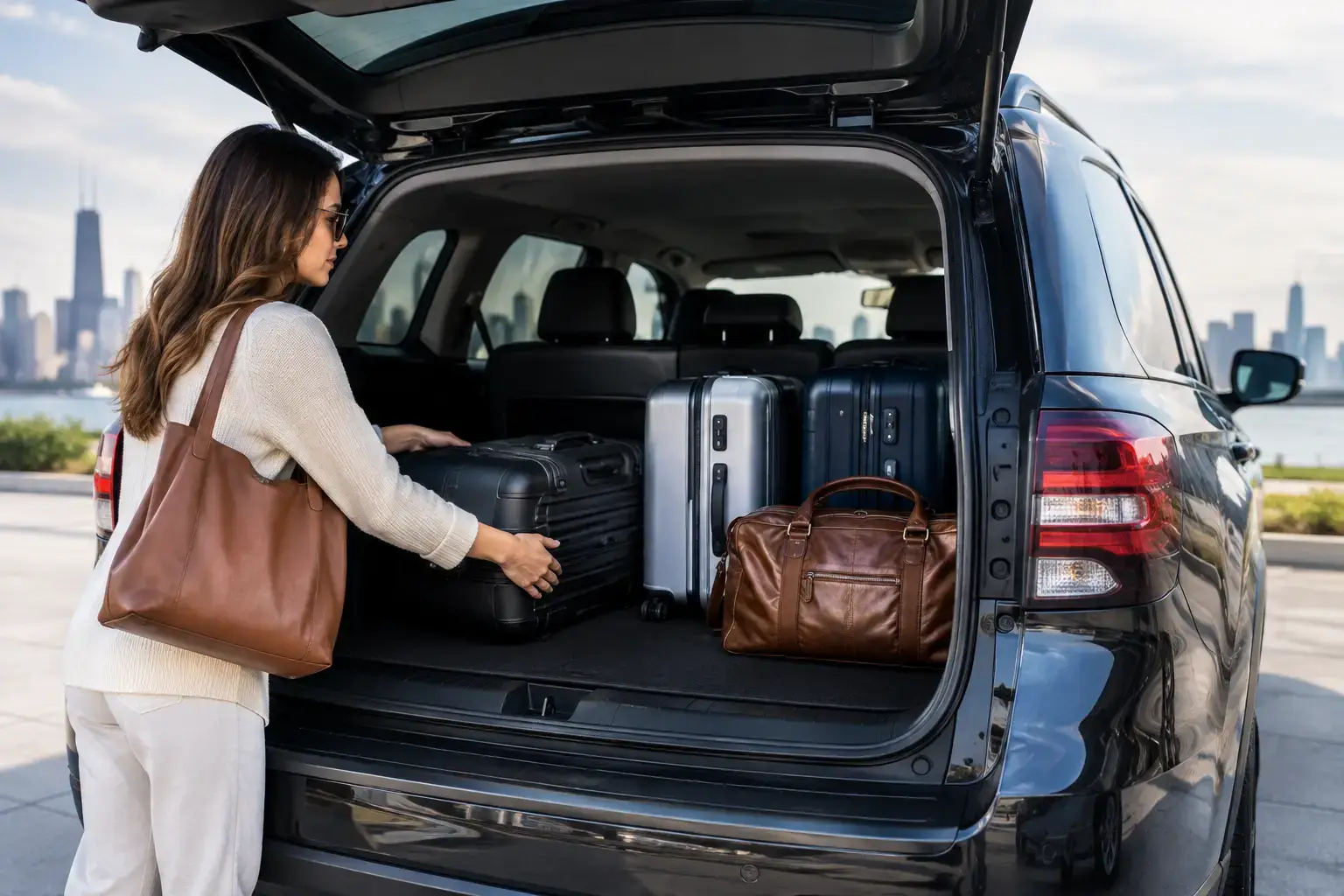
A full-size SUV can look expansive at the curb, yet luggage space changes quickly once every passenger is seated. That is why SUV luggage capacity questions deserve more than a simple passenger count. For an airport transfer, the right vehicle depends on the number, size, and shape of bags, as well as whether everyone expects the same refined level of comfort for the ride.
For travelers heading to O'Hare, Midway, or a private FBO, a few precise details shared during reservation can prevent a cramped cabin, an unnecessary second vehicle, or last-minute changes. Luggage planning is not complicated, but it should be handled with the same care as flight details and pickup timing.
SUV Luggage Capacity Questions Start With the Right Count
The most common question is, "How many bags fit in an SUV?" The useful answer is: it depends on how many people are riding and what type of luggage they bring.
A premium extended-length SUV, such as a Cadillac Escalade ESV or Lincoln Navigator L, offers meaningful cargo room behind its third row. It is an excellent choice for executives, families, and small groups that need a private, first-class airport ride. Still, the available luggage area is shared space. Six passengers with six large checked suitcases require a different plan than four passengers with the same six suitcases.
As a practical planning range, an extended SUV is often well suited to up to six passengers with several standard checked bags and carry-ons. A more comfortable arrangement for travelers bringing large hard-shell suitcases is frequently four or five passengers. With fewer passengers, the cabin and cargo area can accommodate more luggage without sacrificing personal space.
The distinction matters because a vehicle's listed maximum seating is not automatically its best airport-transfer capacity. A third-row seat may be available, but using it reduces cargo room. For a polished arrival or a longer drive from the airport, comfort should remain part of the decision.
Count checked bags and carry-ons separately
A checked suitcase can range from a compact 24-inch bag to a large 30-inch case. Two bags that are both described as "large" may have very different dimensions and packing density. Carry-ons also matter, particularly when each guest has a roller bag, backpack, garment bag, or personal item.
When requesting a quote, state the number of large checked bags, medium suitcases, carry-ons, golf bags, garment bags, strollers, or other oversized pieces. This gives dispatch the information needed to assign a vehicle that fits the complete party, rather than only the people.
Why Passenger Count Alone Can Be Misleading
A reservation for six passengers may sound straightforward until the luggage is added. Consider two typical airport scenarios. A group of six executives traveling overnight with one carry-on each may fit comfortably in a full-size SUV. A family of six returning from a two-week international trip with six large suitcases, two carry-ons, and a stroller may need a different vehicle category.
The issue is not only whether bags can physically fit. Professional transportation should preserve a clear, comfortable passenger area and allow the chauffeur to load luggage securely. Placing bags on seats or crowding passengers with loose items is not the experience most travelers expect after a flight.
Luggage needs can also change between the outbound and return trips. A party leaving home may have fewer bags than when returning with purchases, conference materials, or equipment. If the return transfer will carry more than the original pickup, note it when arranging both reservations.
The third-row trade-off
Large SUVs are designed to carry passengers across three rows. However, the third row and rear cargo area work together. When all third-row positions are occupied, the remaining luggage compartment is more limited. When one or more third-row seats are not needed, additional storage can be available.
This is why a five-person party can sometimes have more luggage flexibility than a six- or seven-person party in the same vehicle. It is also why asking for an SUV by name is less helpful than providing the full travel profile: passenger total, bag count, bag sizes, and any special items.
What Counts as Oversized Luggage?
Oversized items are not a problem when identified early, but they should never be assumed to fit based on a standard suitcase estimate. Golf clubs, skis, camera cases, trade-show materials, music equipment, folding wheelchairs, multiple car seats, and large garment bags all require additional planning.
A golf bag may take the space of several suitcases. A hanging garment bag may need to remain flat or protected from heavy items. Some equipment cases have rigid dimensions that cannot be angled into place. These details can influence whether an extended SUV remains the right choice or whether a Mercedes Sprinter van is more appropriate.
For families, car seats and strollers deserve the same attention. A stroller is often bulky even when folded, and a rear-facing car seat changes the usable room in the second row. Providing the children's ages, car-seat requirements, and stroller type helps create a safer, more comfortable plan.
When an SUV Is the Right Vehicle
A premium SUV is a strong fit for airport transportation when privacy, understated luxury, and direct door-to-terminal service are priorities. It works particularly well for one to five passengers with normal travel luggage, couples carrying several large bags, small executive teams, and families with a manageable number of suitcases.
It is also an excellent option for private aviation arrivals. Travelers can be met at the FBO, planeside where permitted, with timing coordinated around the crew and facility. For these transfers, luggage may include soft-sided duffels, golf clubs, or business materials, so the same advance inventory remains useful.
For longer trips from Chicago to Milwaukee, South Bend, or other Midwest destinations, an SUV provides a composed, spacious setting for a small party. Yet longer drives make personal room even more valuable. Choosing the vehicle with a little extra capacity can make a noticeable difference after an early departure or late arrival.
When to Choose a Sprinter or Executive Minibus Instead
There is a point where adding people and bags to an SUV becomes a compromise. A Mercedes Sprinter van is generally the more comfortable solution for groups with substantial luggage, multiple families, or six or more travelers who each have checked bags. It gives passengers room to settle in while keeping luggage organized in a dedicated area.
An executive minibus is often the more sensible selection for larger corporate groups, wedding transportation, and coordinated airport arrivals. Rather than splitting a group across several SUVs, a single larger vehicle can keep the party together and simplify communication at the terminal or FBO.
The decision does not need to be based on a rigid rule. A group of eight traveling light may be ideally suited to a Sprinter. A group of four with eight oversized cases may need the same solution. The vehicle should serve the actual load, not just the headcount.
How to Give an Accurate Luggage Estimate
The best reservation notes are brief but specific. Instead of writing "lots of luggage," provide a usable picture: five passengers, four large checked bags, two carry-ons, one garment bag, and one stroller. If dimensions are known, include them for unusually large or rigid items.
It also helps to mention whether bags are soft-sided or hard-shell, especially for equipment or specialty travel. A hard case cannot flex into an open area the way a duffel can. If one traveler has mobility equipment or a child requires a car seat, include that information at the outset.
For corporate travel managers arranging transportation for others, confirm luggage expectations with the travelers rather than relying on a standard assumption. Conference attendees, international arrivals, and roadshow teams commonly carry more than a typical overnight passenger. A short pre-trip check can avoid a complicated curbside adjustment.
Chicago Executive Limousine dispatchers can help assess vehicle selection for detailed itineraries, multi-stop pickups, group movements, and airport returns. Flight tracking, 24/7 coordination, and professional chauffeurs handle the timing side of the trip; accurate luggage details make sure the vehicle side is equally well planned.
A Better Standard for Airport Comfort
The best vehicle is not merely the one that can hold every item after careful stacking. It is the one that gives each traveler a proper seat, protects luggage during loading and transport, and lets the chauffeur begin the trip without avoidable delays.
Before confirming an SUV, take one minute to count passengers, checked bags, carry-ons, and special items for both directions of travel. That small step turns a capacity question into a well-organized, comfortable airport transfer.